I was on a call with my somatic coach a couple of months ago, complaining about how exhausted I was. But here’s the thing – every time I tried to actually rest, my chest would tighten. My mind would race. I’d end up cleaning the kitchen or answering emails instead.
“Why does doing nothing feel so scary?” I asked her.
Her answer changed everything.
The Paradox of High-Functioning Freeze
Here’s what I learned: if you’re a high-functioning woman who feels like slowing down is dangerous, you’re not lazy or broken. Your nervous system is doing exactly what it thinks it needs to do to keep you alive.
When we have unresolved trauma – and let’s be clear, trauma doesn’t have to be dramatic – our bodies get stuck in survival mode. That constant doing? That’s your system prioritising protection over rest. It believes that if you stop being vigilant, the threat will return.
This is what we call high-functioning freeze. You look productive on the outside. Inside, you’re running on empty.
I spent years thinking I was just “type A.” Turns out, my nervous system was stuck in what’s called sympathetic activation – the “go go go” state that keeps you moving but never lets you truly land.
When Your Body Fights Rest
The really wild part? Sometimes when you finally try to rest, your system doesn’t just resist – it completely shuts down. You might feel numb, disconnected, or overwhelmingly sad. That’s your nervous system swinging to the opposite extreme, into what’s called hypo-arousal.
It’s like your body only knows two settings: pedal to the metal or completely offline.
I remember the first time I took a proper day off in months. Instead of feeling refreshed, I felt panicked and then completely flat. My system didn’t know how to exist in that middle ground – what neuroscientists call our window of tolerance.
This is why “just relax” advice never worked for me. My nervous system needed to learn that stillness was safe.
The Action Cycle That Never Completes
My coach introduced me to something called the action cycle. It’s simple: we identify a need, take action to meet it, complete the task, and then – crucially – we rest and integrate.
But here’s where most of us get stuck. We skip that final step.
We finish one thing and immediately move to the next. We never let our nervous system register that the “threat” has passed. This creates what I call a nourishment barrier – we can’t actually receive the satisfaction of what we’ve accomplished.
Sound familiar?
This incomplete cycle keeps us trapped in that hypervigilant state. Doing nothing feels threatening because our system is convinced that constant motion equals safety.
Finding Safety, Not Just Calm
The breakthrough came when I learned the difference between external safety and internal safeness. I could be in my comfortable home, but my nervous system was still scanning for danger.
Real regulation – what we call returning to ventral vagal state – happens when we help our body feel genuinely safe. Not just intellectually, but somatically. In our bones.
This isn’t about positive thinking or “good vibes only.” It’s about giving your nervous system concrete signals that you’re not under threat.
A Simple Practice That Actually Works
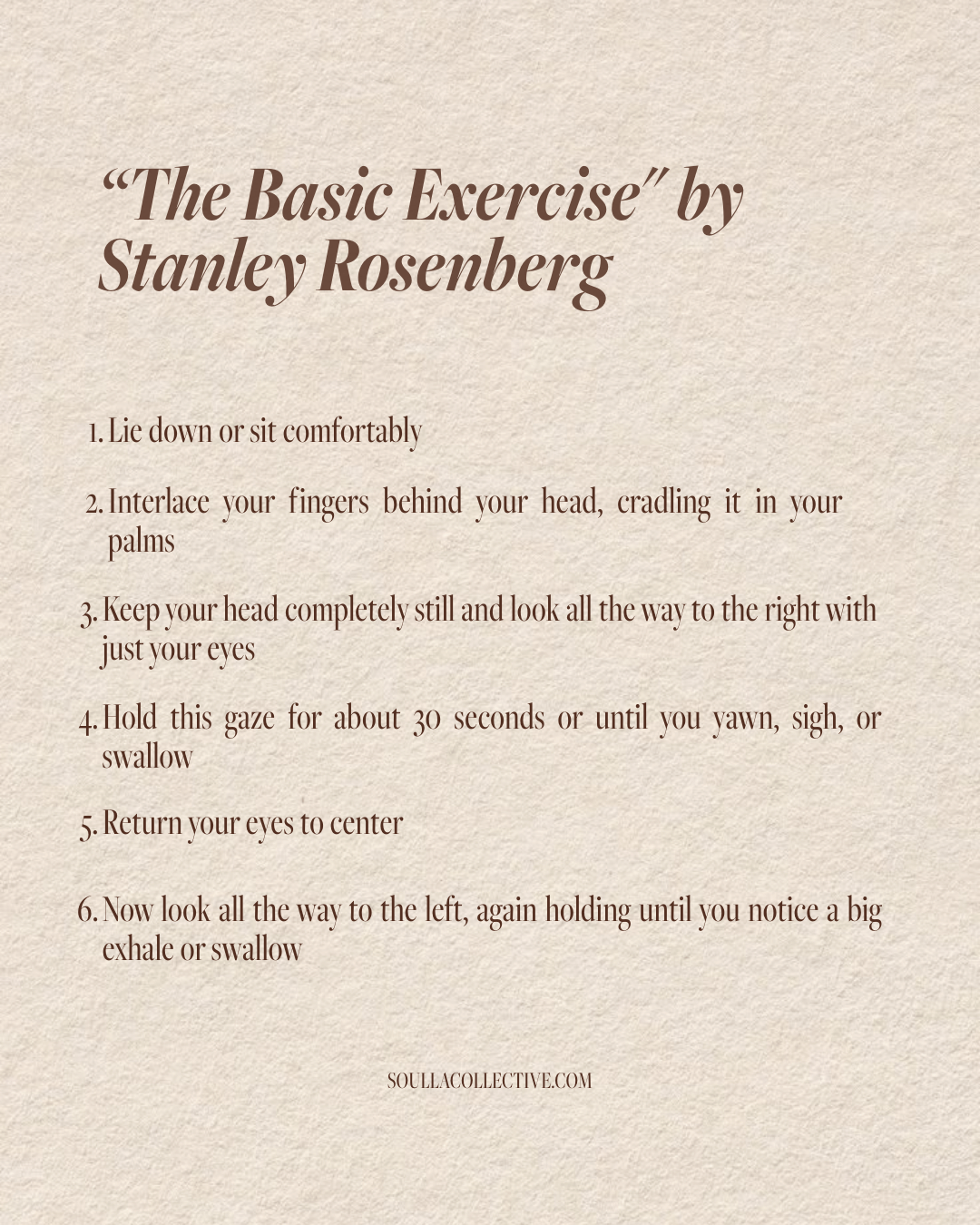
My coach taught me something called the Basic Exercise by Stanley Rosenberg; it’s beautifully simple.
Lie down or sit comfortably. Interlace your fingers behind your head so your head is resting in your palms. Keep your head completely still and look all the way to the right with just your eyes. Hold this gaze for about 30 seconds, or until you yawn or sigh.
Then bring your eyes back to centre, and look all the way to the left. Hold until you notice a big exhale or swallow.
That yawn or sigh? That’s your nervous system releasing tension. That exhale? That’s your vagus nerve re-engaging – sending a direct safety signal to your body.
I still do this practice regularly. Not because I’m “healed” – I still experience that familiar anxiety when I try to rest. But now I have tools that actually work with my nervous system instead of against it.
The Goal Isn’t Constant Calm
Here’s what I wish someone had told me earlier: the goal isn’t to be calm all the time. That’s just another form of perfectionism.
The goal is autonomic flexibility – the ability to move between activation and rest with ease. To complete those action cycles. To let your nervous system flow like a healthy wave instead of staying stuck in one extreme.
Some days I nail this. Other days I’m back to stress-cleaning my flat at 11 PM. I’m still learning. Still practicing. Still surrendering to the fact that healing isn’t linear.
But now when doing nothing feels scary, I understand why. And more importantly, I know what to do about it.
